


Win-Win Bonus
Read the mobile-first version of the report
Associated Content for this Report
Download the full report [PDF]
Press Kit Page
Download the Executive Summary [PDF]
View Appendix A [PDF]
View Appendix B [PDF]
View Appendix C [ZIP]
View Appendix D [PDF]
View Appendix E [PDF]
View Appendix F [PDF]
View Appendix G [PDF]
Report Summary
Recent reforms to California’s longstanding density bonus law (“Bonus Law”) have quietly transformed housing approvals in the Golden State.
For years, California has suffered from affordability challenges. The lack of housing supply drives up costs for everyone. Additionally, too few lower-income households have access to deed-restricted affordable homes.
California’s Bonus Law offers homebuilders a win-win bargain. If they choose to build affordable homes in their projects, then they can receive a package of benefits to more than offset those added costs.
In 2020, Governor Newsom signed Assembly Bill 2345 into law. That bill allows projects that include affordable homes to grow a full 50 percent larger than underlying zoning restrictions would allow. Assembly Bill 1287 in 2023 provided a second stackable 50 percent bonus, if a project includes even more affordable homes. These two pieces of legislation now allow projects with enough affordable units to build to twice the size of their zoning capacity.
Since the adoption of Assembly Bill 2345, Bonus Law has become the most widely used streamlining law tracked by the California Department of Housing and Community Development. It was not understood at the time of its adoption to be a transformative law. Nevertheless, after its adoption Bonus Law has been used to approve:
- More than 140,000 homes overall,
- More than 69,000 deed-restricted affordable homes,
- In 2024, 47 percent of all homes approved in multifamily projects,
- In 2024, 78 percent of all homes in 100 percent affordable projects, and
- In 2024, ten times more homes than every other tracked streamlining law
These recent changes to Bonus Law take seriously the idea that builders will include affordable homes if it is financially advantageous. These reforms were designed to drive win-win rational economic choices by homebuilders.
The incremental changes to Bonus Law resulted in large numbers of new housing approvals, because the reforms built on an existing large baseline of multifamily production.
Bonus Law helps projects achieve their housing capacity by providing strong tools to overcome and repair broken land use rules. The policy has also been bolstered with other more incremental legislative changes, as well as sustained enforcement from the executive and judicial branches.
Changes to data collection practices in California allow for a clearer picture of housing approvals than was possible in earlier years. This presents an opportunity for advocates and policymakers to evaluate the impact of streamlining laws. It should also inform where to spend future efforts, to secure the most impactful policy changes.
The report concludes with a variety of recommendations for how the legislature and California’s housing agencies can further improve the performance of Bonus Law.
California has an opportunity to build on this successful law, to make the California dream more affordable.

Press
- Developers use California’s ‘density bonus’ law far more than higher-profile YIMBY bills, Times of San Diego, April 10, 2026
- Aumenta construcción de vivienda en California impulsada por incentivos estatales, KSDY50, April 10, 2026
- California density bonus law spurs approval of over 140K homes, report finds, CBS 8, April 12, 2026
- Report: California's density bonus is a 'win-win' for developers and affordable housing, Planetizen, April 12, 2026
- What If Inclusionary Zoning Could Actually Work?, The New Urban Order Substack, April 13, 2026 [PDF]
- Where Are All the Cranes?, Arbitrary Lines, April 14, 2026
- When more housing becomes a hard sell, Slow Boring, April 15, 2026 [PDF]
- Housing Lessons from … California?, The Philadelphia Citizen, April 15, 2026
- California density bonus law spurs affordable housing, think tank says, Sacramento Business Journal, April 21, 2026 [PDF]
- The Housing Loophole Arms Race, Jeremy's Quarterly, April 23, 2026
- How San Diego rewired California housing incentives with Colin Parent, Building Better Cities: The Podcast, May 13, 2026
- San Diego Business Journal Insider, Paragraph 3, May 19, 2026
- California’s Density Bonus Works! And That’s Actually The Problem, Legal Planet, June 19, 2026
- California found a housing fix that works. San Francisco is trying to evade it, San Francisco Chronicle, July 11, 2026
- Formal Application For Empire Theater Redevelopment in West Portal, San Francisco, San Francisco YIMBY, July 13, 2026
- Carlsbad approves controversial Village condo project, North County Pipeline, July 29, 2026
- North Park Lands Sixth CEDARst Project as $80M Loan Fuels 197-Unit Tower, Hoodline, August 15, 2026
- Opinion | California has passed hundreds of housing laws. Why aren’t they working?, The San Francisco Chronicle, August 22, 2026
- The Housing that Comes with a Bonus:More Housing, California YIMBY, August 31, 2026
- From ‘Hell House’ to Seven Stories — WeHo Project Seeks 17 Waivers, WEHOnline, September 9, 2026
- Dueling lawsuits contest new San Francisco Family Zoning rules, The Builder's Daily, September 10, 2026
- San Diego Groups Urged Newsom to Sign Bill Easing Path for 140,000 Homes, Hoodline, September 28, 2026
Win-Win Bonus
Associated Content for this Report:
Contents
Executive Summary
What is Bonus Law and How Does It Work?
Recent Enhancements to Bonus Law?
Data Should Inform Policy
The Results - More Affordable and Market-Rate Homes
Lessons Learned - Bonus Law is a Win-Win
Lessons Learned - Large Baselines
Lessons Learned - Repairing Broken Land Use
Recommendations
Conclusion
Executive Summary
Recent reforms to California’s longstanding density bonus law (“Bonus Law”) have quietly transformed housing approvals in the Golden State.
For years, California has suffered from affordability challenges. The lack of housing supply drives up costs for everyone. Additionally, too few lower-income households have access to deed-restricted affordable homes.
California’s Bonus Law offers homebuilders a win-win bargain. If they choose to build affordable homes in their projects, then they can receive a package of benefits to more than offset those added costs.
In 2020, Governor Newsom signed Assembly Bill 2345 into law. That bill allows projects that include affordable homes to grow a full 50 percent larger than underlying zoning restrictions would allow. Assembly Bill 1287 in 2023 provided a second stackable 50 percent bonus, if a project includes even more affordable homes. These two pieces of legislation now allow projects with enough affordable units to build to twice the size of their zoning capacity.
Since the adoption of Assembly Bill 2345, Bonus Law has become the most widely used streamlining law tracked by the California Department of Housing and Community Development. It was not understood at the time of its adoption to be a transformative law. Nevertheless, after its adoption Bonus Law has been used to approve:
- More than 140,000 homes overall,
- More than 69,000 deed-restricted affordable homes,
- In 2024, 47 percent of all homes approved in multifamily projects,
- In 2024, 78 percent of all homes in 100 percent affordable projects, and
- In 2024, ten times more homes than every other tracked streamlining law
These recent changes to Bonus Law take seriously the idea that builders will include affordable homes if it is financially advantageous. These reforms were designed to drive win-win rational economic choices by homebuilders.
The incremental changes to Bonus Law resulted in large numbers of new housing approvals, because the reforms built on an existing large baseline of multifamily production.
Bonus Law helps projects achieve their housing capacity by providing strong tools to overcome and repair broken land use rules. The policy has also been bolstered with other more incremental legislative changes, as well as sustained enforcement from the executive and judicial branches.
Changes to data collection practices in California allow for a clearer picture of housing approvals than was possible in earlier years. This presents an opportunity for
advocates and policymakers to evaluate the impact of streamlining laws. It should also inform where to spend future efforts, to secure the most impactful policy changes.
The report concludes with a variety of recommendations for how the legislature and California’s housing agencies can further improve the performance of Bonus Law.
California has an opportunity to build on this successful law, to make the California dream more affordable.

Figure 1
What is bonus law and how does it work?
Since 1979, California has had a statute on the books titled “density bonus” (Bonus Law).1 Bonus Law has seen many amendments and changes over the years, but in essence, it provides a package of benefits to encourage building deed-restricted affordable homes in new residential projects.
Like many other attempts to reform California law to encourage more housing approvals, Bonus Law has seen relatively little use for most of its history. Earlier estimates found it used on between two and four percent of residential projects.2 In 2003, researchers found that after several decades of Bonus Law’s existence, only one hundred jurisdictions had adopted implementing regulations, out of more than 500 cities and counties in California.3 As recently as 2018, the Terner Center found that the policy was not widely used.4
An unfortunate historical artifact of California Bonus Law is that it is titled “density bonus” in state statutes. It is referred to by practitioners as “density bonus law.”5 But the purpose of Bonus Law is to create deed-restricted affordable homes, not to create density.6 The law provides an array of benefits to participating homebuilders, many of which have nothing to do with density. Moreover, projects can use the program and elect not to receive any additional density whatsoever.
To the extent that a project does utilize increased density, the increased development capacity is available on a sliding scale. The policy functions by first identifying a project’s base density, which is the number of units that could ordinarily be allowed with the current zoning. Using Bonus Law, a percentage of base density is dedicated at some level of affordability, and the project can then build a certain percentage of units above what the base density would otherwise allow. Projects that include units at the deepest level of affordability need to provide relatively fewer restricted units. Projects that dedicate their units at less deep affordability levels must provide more restricted units to receive the same set of benefits.
After the adoption of Assembly Bill 2345 in 2020, projects seeking the maximum of a 50 percent bonus need to set aside from their base density 15 percent at very low-income, 24 percent at low-income, or 44 percent at moderate-income.
Assembly Bill 1287 in 2023 allowed for a second 50 percent bonus to be stacked onto the first bonus. Projects first need to max-out their affordability under Assembly Bill 2345, and then can dedicate up to another 15 percent of their base density at the moderate-income level.
As an example, consider a project proposed for a parcel zoned for 100 units. If that project set aside 15 units at the very low-income level, it would be allowed to build an additional 50 market-rate units. If it also included another 15 units at the moderate-income level, it could build an additional 50 market-rate units. The two 50-unit bonuses would be stacked, allowing the 100-unit zoning to accommodate 200 units.
For very low-income homes, rents may not exceed 30 percent of a household’s income, and must be made available to households making no more than 50 percent of the area median income. Low-income homes are restricted to households with 60 percent of area median income. Moderate-income homes must be priced for households with no more than 110 percent of area median income. There are also a variety of other more esoteric categories with different bonus percentages, including for land donations, senior housing, disabled veterans, and college students.
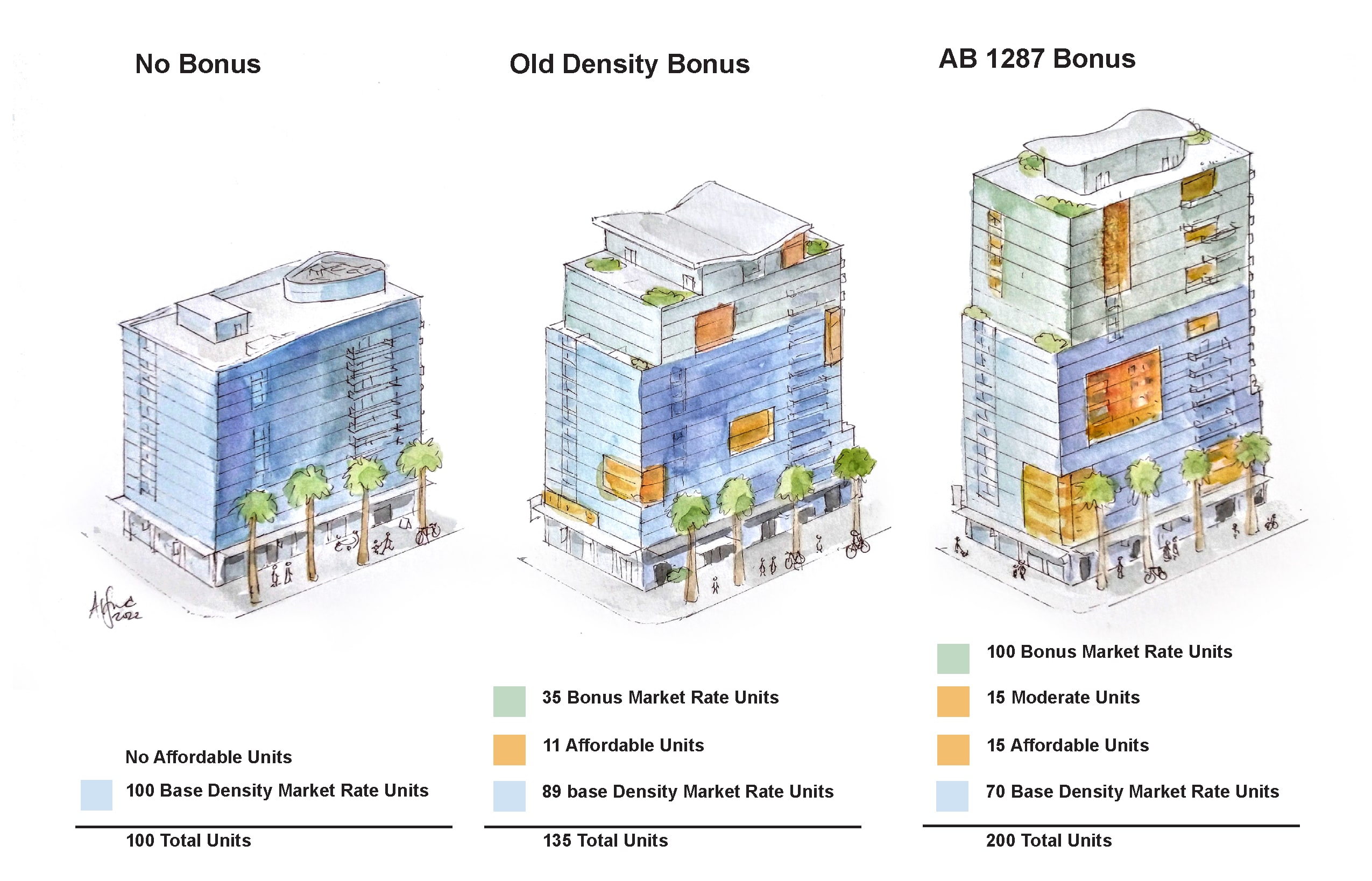
Illustration by Alfred Twu
The actual density bonuses are not the only feature that attracts homebuilders to the program. For projects that include affordable homes, builders may also use tools called “incentives” and “waivers,” which allow the project to deviate from local land use restrictions.
Incentives are fairly open-ended, but homebuilders may use only a few of them on any given project. The number of available incentives is awarded on a sliding scale, with more incentives available for projects that include more deed-restricted units at deeper affordability levels. Incentives can be used to overcome development standards, zoning restrictions, square footage requirements, or parking ratios. The major limiting factor is that an incentive must result in cost reductions to provide for affordable homes.7
Waivers are limited to abrogating development restrictions that physically preclude construction – for example, a height limit or setback requirement that would limit the number of units that could be fit within the building’s envelope. There is no limit to the number of waivers a project may receive.
For both waivers and incentives, the burden is actually upon the local jurisdiction to make findings that any requested benefit is not permissible. That discretion is limited to circumstances that would have an impact to health and safety, or would otherwise be contrary to state or federal law.8
Bonus Law also provides builders with reductions to the amount of parking required on a project. Parking can be a major cost driver, and can limit the total number of homes that can be feasibly built on an individual parcel.9 All projects that qualify under Bonus Law receive a cap for how many parking spaces can be required per unit, depending on the number of bedrooms.10 Bonus Law projects with a sufficient number of affordable units that are within a half-mile of a major transit stop cannot be required to build more than one parking space for every two units. A further reduction to parking ratios is also explicitly available to Bonus Law projects as a permissible use of an incentive.11
Recent Enhancements to Bonus Law
There have been two major changes to Bonus Law in the last five years. Each expanded the amount of development capacity available under the policy, leading to more homes approved under the law.
In 2020, Governor Gavin Newsom signed Assembly Bill 2345 into law, authored by then-Assemblymember Lorena Gonzalez. Circulate co-sponsored it with the national housing advocacy group Up for Growth.12
Assembly Bill 2345 increased the maximum available bonus from 35 percent to 50 percent, on the condition that projects included a higher share of affordable units. To reach the new higher bonus, the bill changed the maximum affordable percentage from 11 percent to 15 percent for very low-income, 20 to 24 percent for low-income, and 40 to 44 percent for moderate-income. An additional incentive was also made available for projects that included the maximum amount of affordability.
In 2023, Governor Newsom signed Assembly Bill 1287 into law, which was authored by Assemblymember David Alvarez. The bill was sponsored by Circulate, the Bay Area Council, and SPUR.13
Assembly Bill 1287 made a second 50 percent bonus available. To qualify for the maximum second bonus, a project must provide the maximum number of affordable units required by Assembly Bill 2345, and also provide an additional 15 percent of base density dedicated for moderate-income homes. The two 50 percent bonuses can be stacked, allowing a full 100 percent more homes than underlying zoning would otherwise allow.
The key feature of both Assembly Bill 2345 and Assembly Bill 1287 is that they took seriously the core concept of Bonus Law, which is that win-win financial incentives can entice homebuilders to build affordable units.
Previous versions of the policy just did not put enough benefits on the table to make participation worthwhile for most projects. Assembly Bill 2345 and Assembly Bill 1287 both took a more muscular approach to the problem. Their benefits push hard on the economics of individual projects. The result is that for many homebuilders, using Bonus Law became a clear winner to maximize their return on investment. And it simultaneously became a winner for families who will have access to new affordable homes.
Data Should Inform Policy
Data on policy outcomes should be used to evaluate the impact of Bonus Law, and inform future reform efforts.
In recent years, the California Department of Housing and Community Development (HCD) has begun to collect and publish data about how much housing is being approved and built in every jurisdiction throughout the state.14 Local governments must submit Annual Progress Reports (APR) to HCD to monitor their progress on housing approvals, permitting, and production.
This APR data is self-reported, and many submissions contain data errors.15 Nevertheless, the APR data still represents the best and most easily available tool to measure progress on housing policy.16
This report uses APR data to evaluate the performance of Bonus Law, and other streamlining laws tracked by HCD. Clear-eyed evaluations of these policy reforms can help policymakers and advocates determine how to prioritize future efforts.
The goals for this report are very much in line with the abundance agenda, to use public policy to gain more of what we say we want, specifically affordable homes.17 It is also aligned with the progress studies movement.18 By learning what policy interventions succeed, we can tailor future efforts to expand that success.
Evaluating California’s APR data shows that Bonus Law has been far more effective than any other streamlining law adopted by the state in recent years.
The Results - More Affordable and Market-Rate Homes
Assembly Bills 2345 and 1287 dramatically increased the use of Bonus Law.
Before the passage of AB 2345 and AB 1287, Bonus Law was not widely used. The passage of these two laws – which increased the amount of bonus available to homebuilders – dramatically increased the law’s effectiveness.
The signing of Assembly Bill 2345 was not understood at the time to be a transformative change to housing policy in California. In fact, the 2020 legislative session was referred to by many as a failure for housing policy. Housing efforts that year were said to “fizzle,” and the session was described as an “epic housing fail.”19 This perspective on the 2020 legislative session has yet to be rehabilitated. At the 2026 Annual California Land Use Law and Planning Conference in Los Angeles, the keynote presentation included a slide reading that “Every year (except 2020) has brought a slew of new legislation,” for housing reforms.20
Despite the lack of attention at the time, Figure 1 shows that the adoption of Assembly Bill 2345 began a steady increase in the number of homes approved using Bonus Law. Those increases continued after the passage of AB 1287 in 2023.
Figure 1

Jacaranda Apartments by Community HousingWorks
Almost half of all multifamily homes approved in California today use Bonus Law.
Bonus Law has become a major tool for multifamily homebuilders in California. Figure 2 below shows that in 2024, 47 percent of all multifamily homes used Bonus Law, up from about 20 percent before Assembly Bill 2345 was enacted.
The number of approvals using Bonus Law increased three-fold between 2020 and 2024, while overall multifamily approvals increased more modestly. Streamlining and density bonus policies can shift the type and location of projects, without increasing total unit production.21 Beginning in 2021, the year-over-year increase in multifamily approvals using Bonus Law exceeded the growth of overall multifamily approvals. This suggests that Bonus Law is both converting many multifamily projects that otherwise may have been approved without the law, and simultaneously increasing the total number of multifamily approvals.

Figure 2
Bonus Law is used far more widely than any other streamlining law tracked in the APR data
In addition to tracking Bonus Law use, the APR data tracks the use of four recently adopted streamlining laws. Those more recent laws include:
- Senate Bill 35 (2017) – By-right approvals for projects that meet certain affordability and labor provisions.22
- Senate Bill 9 (2021) – By-right duplexes and fourplexes in most single-family zoned 23
- Assembly Bill 2011 (2022) – Residential projects on property zoned for commercial 24
- Senate Bill 6 (2022) – Residential projects on property zoned for commercial 25
One of the first studies to make use of APR data was in 2023 from the Terner Center to evaluate the use of Senate Bill 35.26 The Terner Center found more than 18,000 units had applied to use Senate Bill 35. The nonprofit advocacy group YIMBY Law published a report in 2025 using APR data to track the impact of the other tracked streamlining laws.27 YIMBY Law found that despite the “headline grabbing” nature of these bills, “the use of these new laws has been very limited.”28
Figure 3 shows that in 2024, Bonus Law was used for more than 10 times as many approvals as all other tracked streamlining policies combined.

Figure 3

Paseo Artist Village Apartments by Community HousingWorks
Bonus Law increased the number of approvals for deed-restricted affordable homes
The APR data includes not only how many homes are in a project approved using Bonus Law, but also the level of affordability in the unit mix. The purpose of Bonus Law is to encourage the approvals of more deed-restricted affordable homes, and the data displayed in Figure 4 is clear that it is serving its purpose. Large numbers of very low and low-income homes have been approved, with a growing number of moderate-income homes as well.
Since the adoption of Assembly Bill 2345, more than 69,000 deed-restricted homes have been approved using Bonus Law. During that same time frame, more than 72,000 market-rate homes have been approved.

Figure 4
Bonus Law is being used to approve more homes than otherwise allowed by restrictive local zoning.
The APR data shows that many homes approved using Bonus Law are in excess of what would otherwise be allowed by restrictive local zoning codes. The data includes the bonus percentage awarded to individual projects, which allows an extrapolation of how many homes were built above and beyond the local zoning.
Figure 5 shows a breakdown among Bonus Law approvals for the number of base density units, bonus units, and units that were built in projects using Bonus Law, but that did not use any additional density.
Between 2021 and 2023, more than 25,000 homes were approved using the extra density provided by Bonus Law that would not have been allowed but for the policy. More than 19,000 homes were approved in projects that did not use any extra density whatsoever. That indicates the value of the non-density benefits available under Bonus Law.

North Park Seniors Apartments by Community HousingWorks
Even if Bonus Law were not available, some share of the base density approvals would likely have moved forward anyway. Some might even have added capacity over base density through a discretionary approval process. Local jurisdictions have the authority to process zoning changes and to update their land use restrictions on a project-by-project basis. These discretionary approvals are difficult by not unheard of.
The overall approval figures for Bonus Law projects are substantial and have grown significantly in the past few years. Nevertheless, the exact numerical impact on total unit production cannot be pinpointed with perfect confidence.
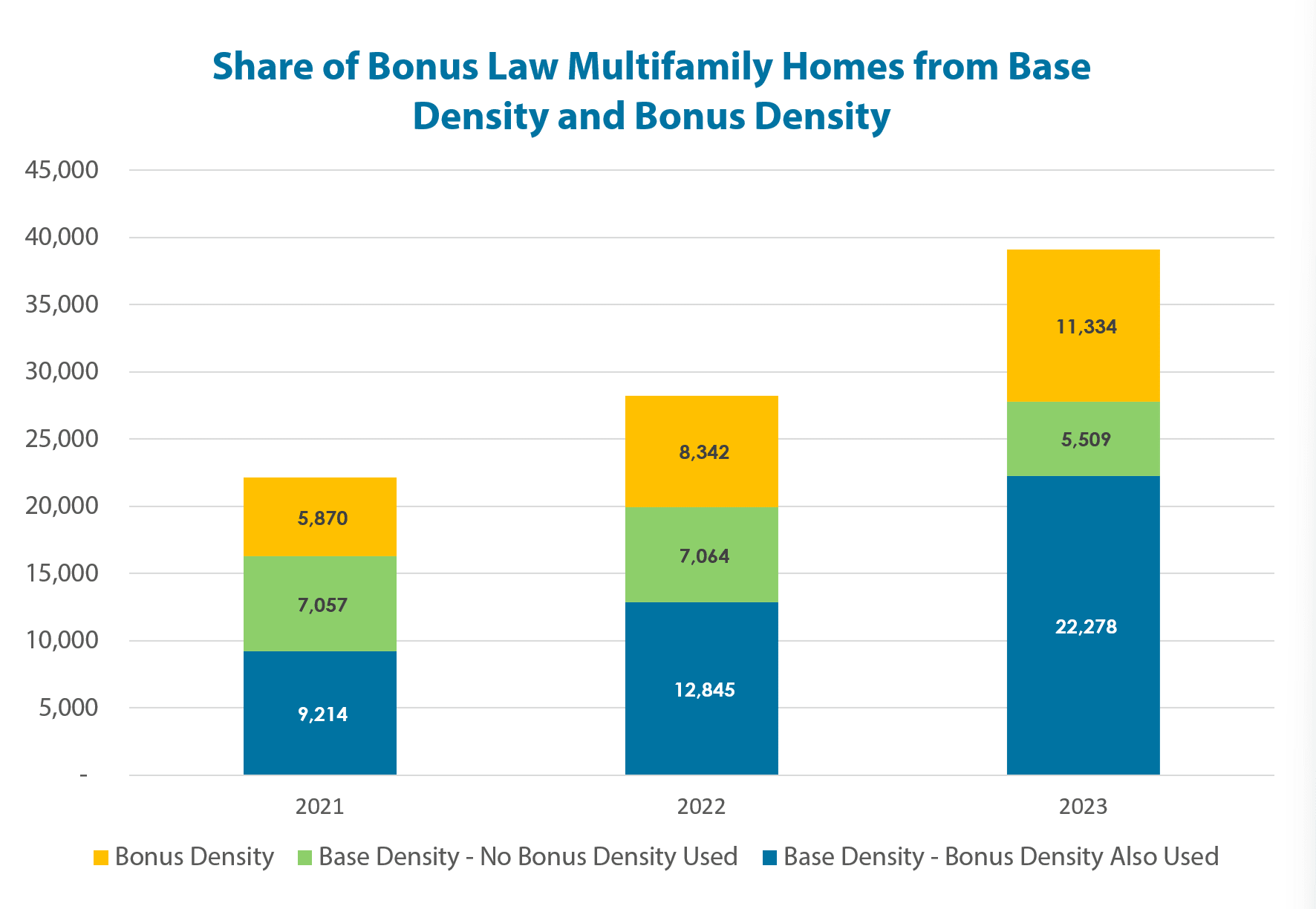
Figure 5
Some projects contain enough affordable homes to qulaify for Bonus Law but do not opt-in to use the policy.
A substantial share of project approvals in California include enough affordable units to qualify for Bonus Law, but do not elect to use the policy. This finding was made available by evaluating the affordability of projects in the APR data, and identifying which of the qualifying projects used, or did not use Bonus Law. Figure 6 shows the share of qualifying projects that do not use Bonus Law.
It is notable that there is a declining share of eligible projects that are forgoing the benefits available to them under Bonus Law. This may indicate that the use of the program is growing not just because of changes to policy, but from growing familiarity with how it can be used. More homebuilders are choosing to use the policy, just as more jurisdictions may be understanding and accepting their obligations under it.29

Figure 6
Bonus Law provides special benefits to 100 percent affordable projects.
In 2019, Governor Newsom signed Assembly Bill 1763, which was authored by Assemblymember David Chiu.30 The bill was sponsored by the California Housing Consortium.31
Assembly Bill 1763 granted 100 percent affordable projects an 80 percent bonus. For affordable projects located within one-half mile of a major transit stop, no density limits could be applied.
Figure 7 shows the use of Bonus Law by 100 percent affordable multifamily projects over time. A larger percentage of 100 percent affordable projects use Bonus Law than among market-rate projects. This should not be surprising, since the main barrier to using Bonus Law is the expense of including money-losing affordable units. 100 percent affordable projects are financed with subsidies to pay for this loss, so the use of Bonus Law does not add any extra expense.
Between 2020 and 2023, 100 percent affordable projects represented a minority of all Bonus Law units. In 2024 it was slightly more than half. Each year they represent a substantial share of all Bonus Law approvals.
The impacts of streamlining policies are more difficult to measure for 100 percent affordable projects. The specific requirements of subsidy programs, and the availability of funding are often the major determinants for what sorts of 100 percent affordable projects are built, and those policies often overwhelm the impact of streamlining laws.
Streamlining tools are also somewhat less impactful to project outcomes, because projects often rely on local subsidy dollars, which are discretionary by nature. While a market-rate or mixed-income project can use a streamlining law to keep their project approval by-right, a 100 percent affordable project often cannot. The same local governments that have authority over entitlement also have discretion over the award of local subsidy dollars. This means that as a practical matter, many 100 percent affordable projects are subject to discretionary approvals, even if their land use entitlements appear to be streamlined or ministerial on paper.
Nevertheless, large numbers of 100 percent affordable projects find value in Bonus Law. Even if it does not allow them to build more profit-generating units, it allows them to accommodate more units overall, increasing the amount of subsidy they are eligible to receive. Similarly, adding more units to a specific project allows certain fixed costs like attorneys’ fees and land purchases to be consolidated across fewer subsidy awards.
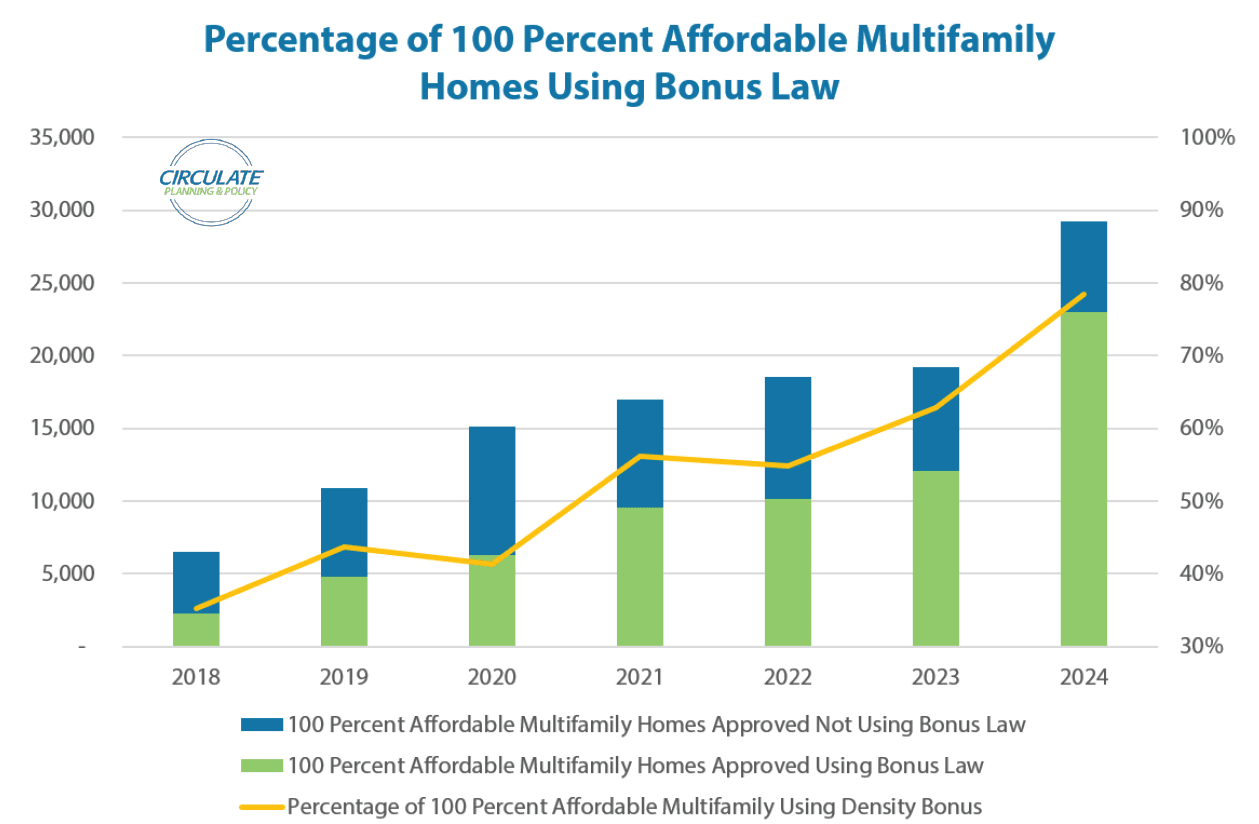
Figure 7

Stella Apartments by Affirmed Housing
Lessons Learned—Bonus Law Is a Win-Win
Bonus Law is a win-win, creating more affrodable homes without sacrificing financial feasibility.
Bonus Law offers a set of benefits that are conditioned on providing affordable homes, but are more than sufficient to offset those added costs. While adding more affordable units would create further losses for a project, Bonus Law compensates by providing an increasing scale of benefits.
For an optional system like Bonus Law to work, homebuilders need the law to be more profitable than choosing not to use it.32 For most of the law’s existence, the bonuses were just too small to pencil out.33
The goal for Assembly Bill 2345 was to provide enough new benefits to change the rational choices of homebuilders and to draw them into using Bonus Law.
Assembly Bill 2345 increased the amount of development capacity a project could receive from 35 percent to 50 percent. That new bonus level would also require an increase for affordable housing set-asides from 11 percent very low-income units, to 15 percent. Pro forma analyses were used to determine the amount of bonus that would be necessary to create a real win-win, and more than offset the costs of providing affordable units.34 The pro formas showed that the 15 percent threshold ate up some of the proposed surplus, but not all of it. It accurately predicted that many future projects would use the new policy.
During the negotiations over Assembly Bill 2345, certain advocates for deed-restricted homes argued that the 50 percent bonus should only be available for projects that include 17 percent of their base density units as affordable for very low-income households. While 17 percent might sound like “more affordable units” than 15 percent, the pro formas showed that in most California markets, such a high requirement would not be any more financially advantageous than the statute as it existed at the time, which capped the affordable set-asides at 11 percent for only a 35 percent bonus. Had the 17 percent set-aside been adopted, projects would not have chosen to use the new policy and there would be no additional affordable units created. For Bonus Law to work as a win-win, the costs of building the affordable units must be more than offset.
The advocacy for Assembly Bill 2345 was helped by the fact that for years, the City of San Diego had been producing more affordable homes using the formula of 15 percent very low-income in exchange for a 50 percent bonus. In 2014, a working group at the San Diego Housing Commission developed a recommendation for the City of San Diego to provide a 50 percent bonus, over and above the 35 percent that was available through California’s Bonus Law.35 The win-win proposal was adopted by then-Mayor Kevin Faulconer, and it was approved with a unanimous vote from the San Diego City Council in 2016.36
The importance of San Diego’s enhancements to Bonus Law was recognized at the time. The head of the local Building Industry Association noted that “The best thing the mayor has done is adopt a better density bonus program than most cities.”37 Over the years, Circulate published several studies on the success of the local program,38 and city-wide bonus programs continue to represent a majority of housing permitting in San Diego.39 Armed with the data available from the performance in San Diego, the legislature was able to make an informed decision about the potential to improve Bonus Law statewide.
Bonus Law succeeds in part because it is not an, "everything bagel."
Writer Ezra Klein has coined the term “everything bagel liberalism,” a phenomenon where many well-intentioned but costly requirements undermine the effectiveness of policies.40 The relatively weak impact of recent housing reforms has been credited to “the persistence of bagel toppings… [which] render many of the potential… buildings authorized by the new state laws economically infeasible to build.”41
Instead of “everything bagels,” the solution some have argued for are “plain bagels,”42 – reforms to allow for more homes without strings attached, which presumably would result in more housing production overall.
But there is a spectrum between “plain bagel” policies with no requirements, and “everything bagel” policies with so many requirements that they are of no use. These might be called “poppy bagel” policies – policy tools with some requirements, but not too many.43 And of course, in addition to being a popular topping for bagels, the poppy is the California state flower.
Bonus Law is a good example of a “poppy bagel” policy. It has set-asides, so it is not a plain bagel. And it is being used extensively, so it’s not a do-nothing everything bagel. Its set-asides have costs, but for many projects those costs are more than offset.

Kimball Highland Apartments by Community HousingWorks
Source: Photo by Chipper Hatter
Bonus Law can transform inclusionary mandates into a win-win.
Many local jurisdictions in California have an “inclusionary housing” policy that requires homebuilders to deed-restrict a certain percentage of their units as affordable.44 Bonus Law can help market-rate homebuilders offset the costs of those deed-restricted units, by allowing them to build more profit-generating units, or to take advantage of the other benefits under the law.
There are generally two justifications for local inclusionary housing policies. The first is that they are a form of tax on market-rate development, to shift some of those expenditures toward affordable housing. On-site affordable units or an in-lieu fee would satisfy this goal. The second is that they are a mechanism of inclusion, to redress longstanding patterns of economic and racial segregation. This would only be accomplished if a project actually includes on-site units. An in-lieu fee simply would not serve this function.
Bonus Law has no option for in-lieu fees, so with few exceptions, any project taking advantage of it must build affordable units on-site. Courts have held that affordable units under Bonus Law can be used to satisfy local inclusionary obligations.45 For projects subject to local inclusionary mandates, the use of Bonus Law becomes an easy decision. The costs of the affordable on-site units are already baked into their pro forma, so using Bonus Law does not generate additional costs. Bonus Law then becomes a win-win. The local jurisdictions get the affordable units they require, and homebuilders receive offsetting benefits to help the financial feasibility of their projects.
Critics of inclusionary zoning argue that inclusionary mandates make projects more expensive, driving up rents for market-rate households. Bonus Law allows them to see a victory because many of those harmful costs can be offset. Advocates for inclusionary housing can also see a benefit. Bonus Law makes more feasible their policy preferences to build on-site affordable units in new market-rate projects.
The win-win nature of Bonus Law is a model for legislative success.
Many California legislators are eager to limit local jurisdictions from blocking new homes. At the same time, progressive legislators often demand affordable housing set-asides as a condition for their votes for pro-homes legislation.
Bonus Law strikes a bargain between these two competing forces. Proponents of new homes see value in the policy because it helps more residential approvals. Advocates for deed-restricted homes see it as a useful tool to build affordable units, and to help 100 percent affordable projects. Legislation that attracts support from the affordable housing community may also deter opposition from others in the progressive coalition, like development-skeptical environmental groups.46 The win-win nature for many bills to improve Bonus Law has helped keep the incremental reforms to the policy fairly noncontroversial. A recent analysis found that laws to enhance Bonus Law received some of the least opposition in the legislature, among all types of housing reforms.47
Assembly Bill 2345 is a good example of this win-win dynamic. Projects can only take advantage of the new increased bonuses if they provide more affordable homes.
Assembly Bill 1287 has the same win-win rationale. It requires that projects max-out the affordable units called for under Assembly Bill 2345, and then build moderate-income units, before they can be eligible for an even more lucrative stacked bonus.
By contrast, efforts to amend Bonus Law without a win-win formula have faced challenges. Some legislation has been proposed to provide similar benefits to projects as what Bonus Law would provide, but with lower housing requirements. These proposals have often faced serious opposition and have been defeated.
The same year that Assembly Bill 2345 was introduced, another effort was made to reform Bonus Law. Senate Bill 1085 attempted to create different criteria to receive the benefits of Bonus Law.48 An analysis from the Terner Center showed that the bill attempted to provide additional bonus benefits, for lower numbers of affordable units than the preexisting law.49 This did not follow the win-win formula of Assembly Bill 2345, and Senate Bill 1085 was defeated.
Lessons Learned—Large Baselines
Streamlining policies are more impactful when the baseline is already relatively large.
A key reason why Bonus Law produces more approvals than other recent streamlining policies is that it provides an incremental boost to an already-large baseline of multifamily approvals. Between 2018 and 2024, the APR data shows that each year, between 71,000 to 97,000 homes were approved in the multifamily category.50 Generally speaking, these are apartments and condos.
Bonus Law is not limited to multifamily projects, and can be applied to many forms of residential development. However, the program is limited to projects with five or more units.51 As a practical matter, about 95 percent of all units approved using Bonus Law are in the multifamily category. Evaluating the impact of Bonus Law is mostly an exercise in how it impacts multifamily approvals.
As shown in Figure 2, Bonus Law approvals grew between 2021 and 2024 at a faster rate than the increases in multifamily approvals overall. This suggests that the enhancements to Bonus Law from Assembly Bill 2345 played a major role in the growth of multifamily approvals during this time. In 2018, Bonus Law projects accounted for 24 percent of all multifamily units approved. In 2024, that number rose to 47 percent.
Between 2021 and 2024, Bonus Law approvals increased each year over the prior year between 12 percent to 43 percent. For some years, that improvement accounted for the approval of more than 10,000 units above the prior year. While the percentage increase may appear incremental, the absolute unit gains were large because they built on an already substantial baseline.
The political economies of large-scale reforms to Bonus Law are favorable to adoption.
It might seem surprising that legislation to dramatically expand the scope and impact of Bonus Law would see so little effective opposition, and win passage time and again. One might imagine that a policy that impacted such a wide range of jurisdictions, property owners, and stakeholders would attract an equally large set of opponents.
In practice, the broad baseline and impact of Bonus Law actually improve the political economies for reform.
State-level preemption of local land use rules is not new, nor is it limited to California.52 In recent years, many successful reforms for housing policy have been through statewide efforts.53 This reflects a strategic choice by housing advocates to propose policy reforms where they are less likely to face effective opposition.
Political science has long understood that small groups can oftentimes secure public policy goals disproportionate to their size.54 Smaller groups are easier to organize and motivate, and can secure policy wins at the expense of the broader public. Small groups of anti-housing voices are more often stirred to oppose housing in their local
vicinity, and they can be effective at blocking new housing that would provide diffuse benefits to the public. Those same local groups are less motivated to oppose more diffuse citywide55 or statewide changes.56 Statewide efforts help to keep individuals, jurisdictions, or other stakeholders from feeling singled out. As a result, they are less eager or capable to organize against statewide policy reforms.
The broad applicability of Bonus Law to nearly any residential project, so long as it has some affordable units, helps facilitate its success. Others have suggested that reforms with such characteristics are strategically valuable, arguing that “a single standard statewide would be clearer and fairer, and it would decrease the political temptations to use the varying standards to carve out exemptions for favored constituencies.”57
The idea that California needs more affordable homes, and should streamline their approvals is broadly appealing. One view of Bonus Law might be that it “pairs an innocuous normative idea with statutory particulars that are too complicated for anti-development interests to mobilize public opinion against.”58 A more charitable view is that the law helps effectuate high-minded policy ideals into actual policy outcomes. If policymakers can agree in principle that we should allow for more affordable homes, then rules can be crafted to apply those principles across a broad set of circumstances. Bonus Law ties governments to the mast to prioritize affordable housing approvals, even if down the road the streamlining for individual projects may be politically inconvenient.
Lessons Learned —Repairing Broken Land Use Rules
Bonus Law provides a universal Swiss Army knife of effective tools.
There are many different types of land use restrictions in California, and they differ from jurisdiction to jurisdiction.59 Many land use restrictions are quite specific, regulating many detailed elements of new projects.60 Zoning rules often claim to allow a certain amount of housing, but related land use rules can prevent that full amount of housing from being approved. Limitations to building heights and setbacks can prevent buildings from having the envelope necessary to accommodate the full unit capacity that exists on paper.61 Other restrictions like parking and open space requirements may not directly mandate characteristics of a building, but still physically prevent projects from utilizing a parcel’s full zoning capacity.62
In essence, many local land use rules are broken. They simply do not allow in application for the kind of development they say they do. Bonus Law provides a variety of tools to help build the types of projects that local land use plans say they will allow.
If parcels are under-zoned such that a building is not financially feasible, the density benefits from Bonus Law allow some projects to overcome those challenges. If local parking minimums are excessively high, Bonus Law allows homebuilders to make their own judgment about the parking necessary to market their project to new renters or buyers.
Incentives and waivers in Bonus Law are intended to help cut through the myriad other restrictions that result in broken local land use rules. Infill projects often face geometrical constraints specific to an individual property. Incentives and waivers provide flexibility on heights, setbacks, and building envelopes, which can determine whether many such projects are financially feasible. The non-density benefits available through Bonus Law can be more valuable to an infill builder than the density increases themselves.
Incentives and waivers are unusual tools in land use, even for statewide preemptions of local authority. Instead of banning certain types of local practices like excessive setbacks or height limits, Bonus Law acknowledges that it would be impossible to predict exactly how creative local governments may try to restrict housing. Instead, Bonus Law provides a universal Swiss Army knife, capable of addressing any prohibitive restriction to new housing. They do not merely repair broken zoning laws already on the books, but also are intended to cut through future restrictions that have not yet been devised or implemented.
Land use restrictions are often comprehensive, and indicative of a broad antipathy to new housing. Jurisdictions with high levels of restrictions on one set of policies tend to have heavy restrictions on others.63 This means that banning one sort of restrictive policy would not necessarily make projects any easier to approve, because restrictive jurisdictions have a variety of alternative tools available to them. They have been described as a “hydra,” where if one restriction is defeated, others will grow to take their place.64
Housing advocates – and even many planners – may pine for a system that is more coherent, where zoning plans mean what they say. They want local jurisdictions to make good faith efforts to provide for a sufficient supply of new homes. Even housing advocates have expressed a desire for housing not to depend on the “weird hack” of Bonus Law.65
Bonus Law takes a different approach. It accepts that planning regimes will often seek new and creative strategies to micromanage or to prevent new housing. Instead of trying to preempt unworkable and broken land use rules in the planning stage, Bonus Law provides housing the necessary tools to repair them in application.
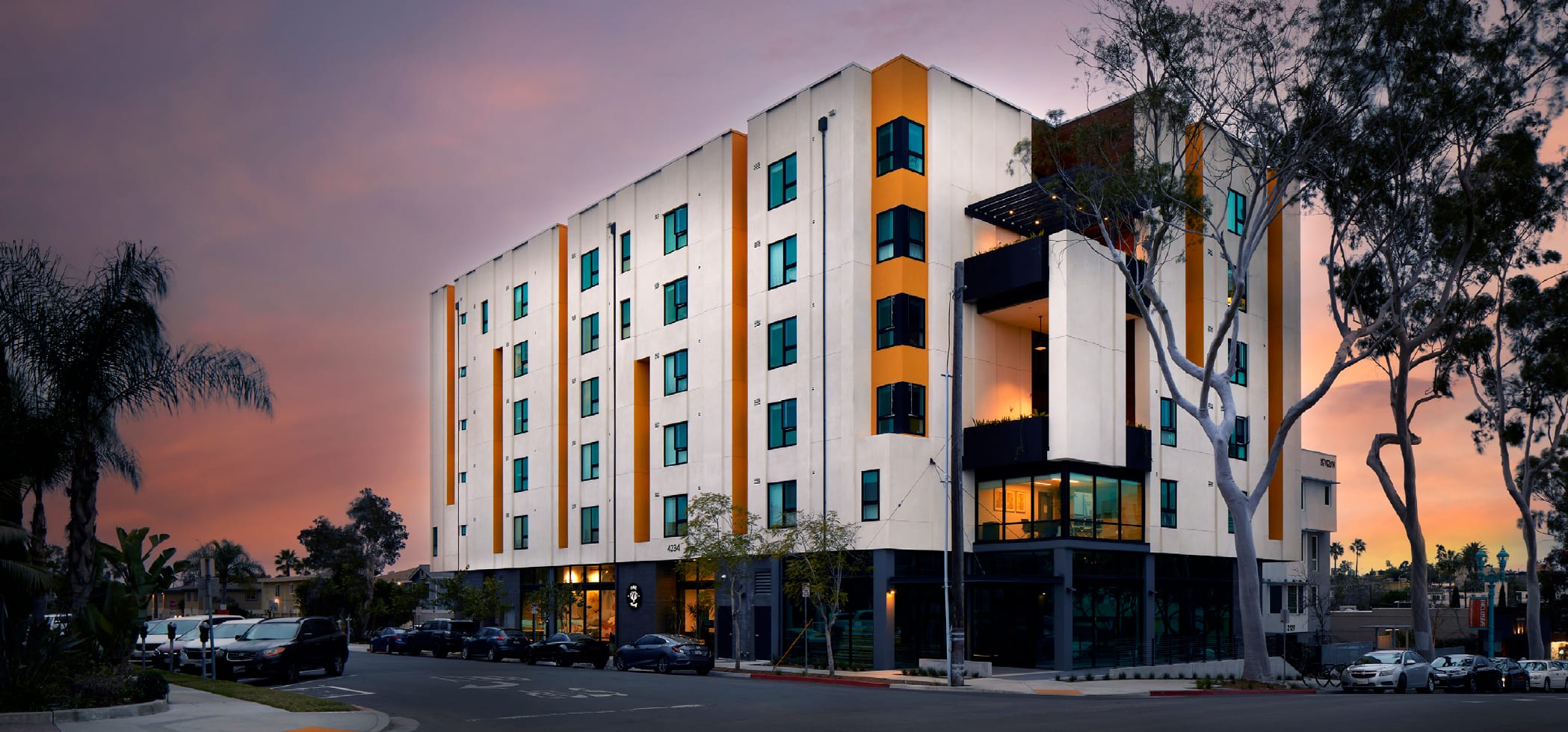
One Mississippi Apartments by Trestle Development
Source: Courtesy of Trestle Development
Bonus Law preserves local control over basic Euclidean zoning.
Bonus Law provides powerful tools that can overcome many local planning restrictions. However, the law protects many elements of local control, especially the most basic and long-established functions of local governments.
Bonus Law does not prevent local governments from exercising their traditional powers for Euclidean zoning. The law does not allow for residential projects in places zoned for potentially incompatible uses like commercial or industrial. Bonus Law is generally limited to allowing homes to be built where local jurisdictions already said they could go.
Relatedly, Bonus Law does not require jurisdictions to build multifamily housing where they had decided to allow only single-family homes. By so doing, it avoids one of the more divisive and politically challenging goals of the modern YIMBY movement.
Bonus Law allows for substantially more homes on an individual parcel than underlying zoning would allow. But with the exception of 100 percent affordable projects near transit,66 that added capacity is limited to no more than twice what the base zoning would allow. Local governments generally still get to decide where to locate bulk and scale. Their powers under Bonus Law are abrogated, but by no means extinguished.

Merian Apartments by Holland Partner Group
Source: Courtesy of Holland Partner Group
Bonus Law faciliates CEQA exemptions.
The California Environmental Quality Act (CEQA) has been a common tool to block housing. Comprehensive CEQA reform has been elusive, but there have been a variety of exemptions adopted to the law, many of which apply to housing.67 CEQA exemptions often require that a project be compliant with local plans.68
The trouble with limiting CEQA exemptions to projects that comply with local plans is that many projects cannot feasibly be built without departing from those plans. Such departures are generally discretionary actions, voiding the exemption and requiring a burdensome CEQA analysis.
Bonus Law expands the universe of projects that are considered compliant with preexisting plans, and therefore eligible for CEQA exemptions. Density increases, parking forgiveness, incentives, and waivers are all granted under Bonus Law in a non-discretionary manner. Bonus Law projects are considered compliant with local plans, even though they use the benefits of the law to meaningfully depart from those plans. Courts have found that “modifications and waivers under the Density Bonus Law do not prevent a project from qualifying for a CEQA infill exemption, even if these changes deviate from existing zoning.”69 This has been reaffirmed in statute.70
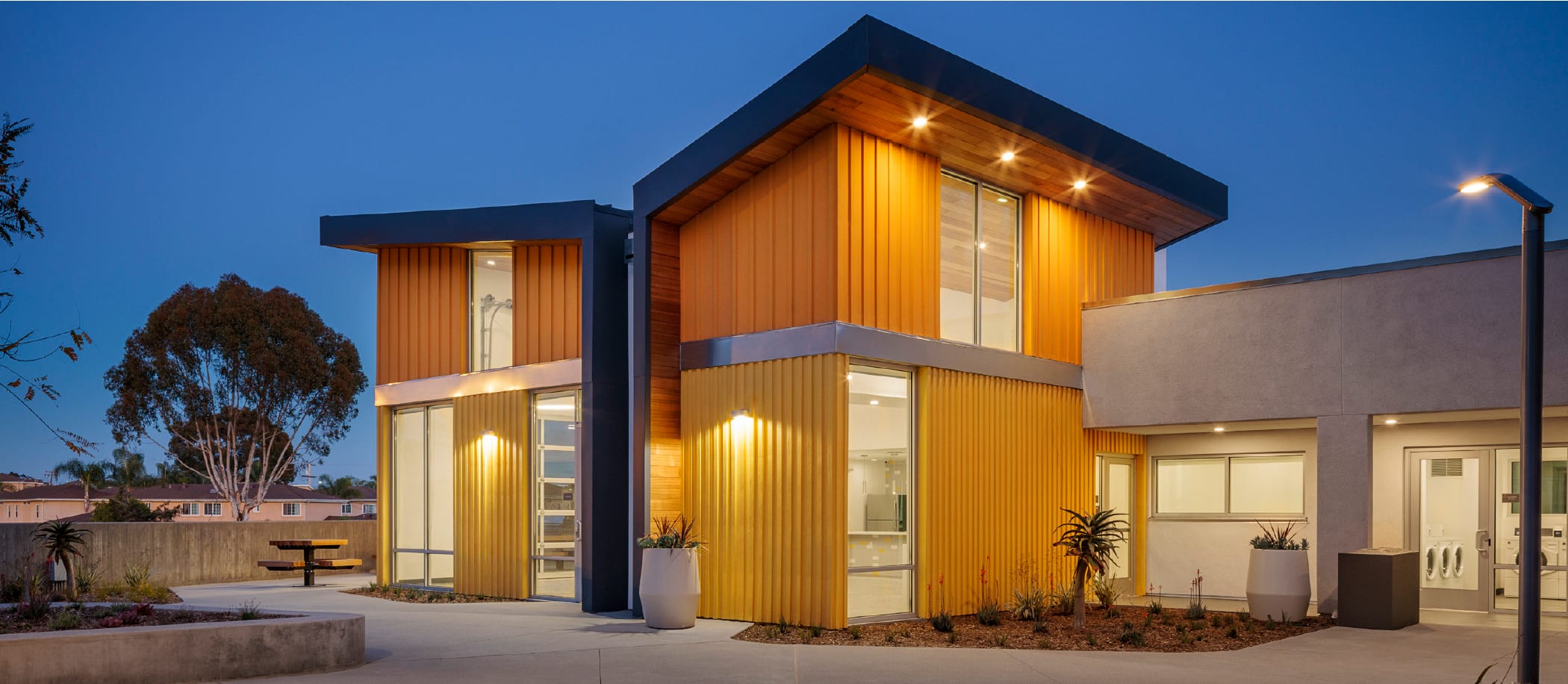
Puesta Del Sol Apartments by Community HousingWorks
Source: Photo by Chipper Hatter
Bonus Law enables more projects to benefit from the Housing Accountability Act.
Like with exemptions for CEQA, the Housing Accountability Act (HAA)71 provides homebuilders with a degree of entitlement certainty. In particular, a local government may not reject a housing project that complies with local land use rules, except under limited circumstances.
Departures from underlying land use restrictions awarded through Bonus Law do not stop a project from being treated as compliant with local land use rules under the HAA. Courts have ruled that “By utilizing the incentives, concession and waivers mandated by the Density Bonus Law, the project will satisfy the applicable objective zoning standards. As a result, the developer can gain the protections of the Housing Accountability Act.”72 The California Department of Housing and Community Development also advises local governments that the use of Bonus Law to depart from a local plan does not invalidate its protection from the HAA.73
Without the benefits of Bonus Law, it would be a simple thing for local governments to subvert streamlining laws like CEQA exemptions and the HAA. All they would need to do is to adopt broken local land use rules, and force projects to seek discretionary departures from their unworkable restrictions.
A clear path to entitlement makes projects measurably more valuable to homebuilders, and can help attract capital. Recent research has demonstrated that in Los Angeles, property with secured approvals can command a 50 percent price premium.74 Bonus Law, combined with other laws for entitlement certainty can help more homes find necessary financing.
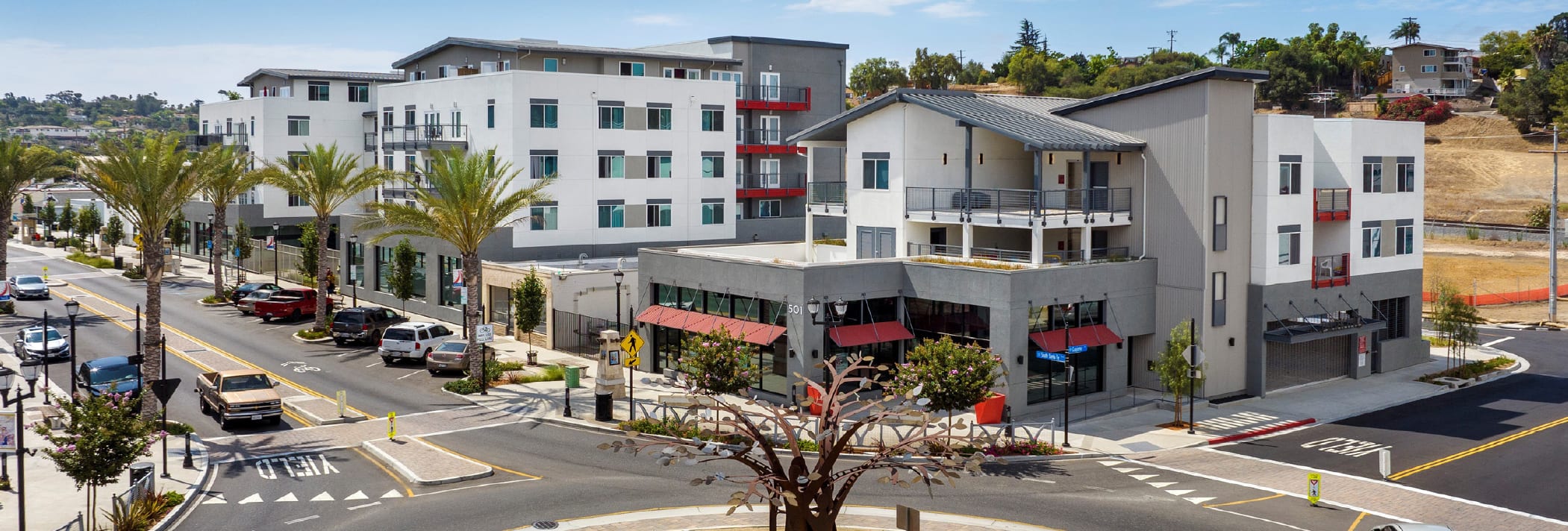
Paseo Artist Village Apartments by Community HousingWorks
Source: Chipper Hatter
The success of Bonus Law to overcome local land use restrictions required a sustained effort by all three branches of California government.
Bonus Law is not self-executing. For Bonus Law to have such a broad impact, it has required a significant political consensus among various branches of government over a sustained period of time.
Within the last 10 years, the California legislature adopted more than 20 different bills related to Bonus Law. A recent study found that the two housing topics that saw the most California legislation adopted in the last decade were for Bonus Law and for the Housing Element process.75
While Assembly Bill 2345 and Assembly Bill 1287 were the most dramatic and measurable changes to Bonus Law, incremental improvements through other legislation helped shore up the law and improve its usefulness. Many of these relatively small changes were made by the legislature to plug holes discovered through implementation. When local governments devised clever and bad faith strategies to get out of their obligations under Bonus Law, the legislature has frequently stepped in to reaffirm its intentions.76 A list of Bonus Law bills adopted between 2016 and 2024 are included as an appendix.77
Judicial decisions over the years have consistently held that the broad goals articulated by the legislature for Bonus Law should be given full effect. Perhaps the most important cases relate to affirming the strong and flexible rules for incentives and waivers, which most clearly abrogate local authority to restrict new housing.
The Bankers Hilland Wollmerdecisions made clear that Bonus Law incentives and waivers do what they say under statute, and can override all manner of local land use restrictions.78
Courts have routinely found against local governments that attempt to undermine Bonus Law by adding new and creative requirements. Local governments are not allowed to condition the granting of incentives with increased requirements.79 Nor can they require additional and infeasible affordability mandates, under the guise of trying to achieve even more affordability.80 Judicial decisions have ensured that the calculations for base density can rely on the highest available options among competing and inconsistent local rules.81 They have also allowed cities to grant even more density through incentives.82
While courts and the legislature have the power to create or propound the law, executive authorities have also played a key role. Aggressive and effective enforcement for California’s housing laws has been a relatively new phenomenon.83 HCD’s Housing Accountability Unit provides technical assistance and advisory letters when requested by local jurisdictions, or in response to complaints filed by the public.84 They can act faster, and upon more circumstances than the courts or the legislature. To date, HCD has issued 107 letters related to Bonus Law. It is the third most common subject area for their enforcement letters, behind only Housing Element Law and the Housing Accountability Act.85
The California Attorney General Rob Bonta formed a Housing Strikeforce in 2021, which has taken its own executive and legal actions.86 The California Department of Justice sent letters threatening suits against local governments for ignoring Bonus Law.87 Their office brought a suit against Huntington Beach for violating Bonus Law.88 They also reached a settlement with the City of San Bernardino which included an agreement to amend its local ordinance to fully comply with Bonus Law.89
The relatively incremental changes to Bonus Law likely helped secure its success. Incremental changes tend to see less resistance from the staff and subordinate governments that must implement them.90 Homebuilders have seen local jurisdictions gradually acquiesce to their obligations under Bonus Law.91
Bonus Law is not the result of a one-time political deal at the end of a single legislative session. Time and again, it has been reaffirmed and strengthened through dozens of bills supported by a broad political coalition.92 Decades of judicial decisions, and a growing number of enforcement actions provide a strong bulwark for the implementation of Bonus Law. The law is not new, and it is not untested. More recent streamlining laws simply cannot benefit from these fortifications.

Stella Apartments by Affirmed Housing
Source: Courtesy of Affirmed Housing
Recommendations
The success of Bonus Law during the prior five years has been unmistakable. Still there is room for improvement. Over the life of Bonus Law, the legislature has adopted dozens of bills to expand its benefits. The success of the program should not be cause to stop making those iterative adjustments, but to redouble the efforts.
Bonus Law should be renamed.
The formal name in California’s statutes is “density bonus.” That name no longer accurately describes the function of the program, and it arguably never accurately described its purpose. The purpose of Bonus Law is to encourage the production of deed-restricted and permanently affordable homes. “Density” is merely one of several tools available to projects that elect to build affordable homes. Keeping the term “density” in the name of the law is both misleading and unnecessarily divisive.
Renaming the program around its purpose to build affordable homes will help legislators, local officials, practitioners, and activists to more effectively advocate for the program against its detractors.
Assembly Bill 1287 should be available to 100 percent affordable projects.
Bonus Law allows 100 percent affordable homebuilders to receive up to an 80 percent bonus, or an unlimited bonus for projects that are near transit or are in areas with low vehicle miles traveled. Assembly Bill 1287 allows mixed-income projects to receive up to a 100 percent bonus, if they include a mix of affordability, including homes that are deed-restricted at the moderate-income level.
Recently, HCD issued an advisory letter saying that Assembly Bill 1287 requires that for units to qualify, they must be reserved for households that earn at least enough to be in the moderate-income category.93 HCD is treating Assembly Bill 1287 as both an income ceiling, and an income floor. HCD’s interpretation creates an unintended donut, where certain 100 percent affordable projects find their bonus capped at 80 percent, while mixed-income projects in the same geography can have up to a 100 percent bonus.
A simple legislative fix could change Bonus Law to allow for units at deeper affordability to qualify for the second stacked bonus under Assembly Bill 1287.
Bonus Law benefits should become automatic for all projects with the qualifying percentage of affordable homes.
Currently, Bonus Law operates as an opt-in program. Simultaneously, there are many local governments that have local inclusionary requirements that are mandatory.
Many projects that build inclusionary units to comply with local mandates therefore become eligible for the benefits of Bonus Law.
As shown in Figure 6 above, a substantial share of projects that have enough qualifying affordable units are nevertheless not opting to use Bonus Law. The APR data does not explain why. Presumably there are some set of projects for which the local zoning codes are perfectly aligned to the developer’s preferences, though those seem likely to be rare. Even if the projects do not need any additional density, the incentives and waivers would be at least somewhat useful.
Interviews with homebuilders suggest a more troubling reason. Some hesitate to use Bonus Law because they are worried about retaliation from the local permitting jurisdiction. Many local decisionmakers are naturally guarded over their authority to control development. Bonus Law abrogates their authority. Homebuilders can be reasonably worried that unsupportive jurisdictions can act in bad faith to frustrate, delay, or ultimately defeat their projects. For some projects, not using the benefits entitled to them under Bonus Law is the wise choice, discretion being the better part of valor.
Bonus Law could be amended to reshape this dynamic. Instead of putting the onus on the builder to opt-in to Bonus Law, the policy could be made to automatically apply to all projects that include the necessary affordable units. For any project that proposed to satisfy their inclusionary obligations with enough on-site units, it would be treated as a Bonus Law project, and all of the benefits of the policy would be extended to it automatically. Homebuilders would be relieved from the burden of decision, and local officials would have less cause to exact retribution against their projects.

Stella Apartments by Affirmed Housing
Source: Courtesy of Affirmed Housing
The protections for afforable homes under Bonus Law should apply to the Coastal Commission.
The Coastal Commission has a well-documented record of slowing and frustrating affordable housing approvals within its jurisdiction. Circulate documented the abuses of this process by the Coastal Commission in our report “A Better Coastal Commission.”94
Within the Coastal Zone, Local Coastal Plans are adopted by local governments to determine where multifamily projects may be developed, and they are then ratified by the Coastal Commission. When certain compliant projects are approved by a local government, they are subject to an appeal to the Coastal Commission. Upon appeal, projects must navigate an unpredictable morass that can last for years.
One of the few areas where the courts have not strengthened Bonus Law is its application to the Coastal Commission. Kalnel Gardens, LLCfound that Bonus Law did not supersede the Coastal Act.95 The legislature responded in 2018 with Assembly Bill 2797, which requires that any benefit, incentive, or waivers granted under Bonus Law be harmonized with the California Coastal Act.96 The Coastal Commission has treated these decisions as having no limitation on their authority to demand changes to projects that include affordable homes and rely on Bonus Law.
Bonus Law can be strengthened by requiring the Coastal Commission to follow the same rules for granting Bonus Law benefits that are required for cities and counties. This would not require the Coastal Commission to approve housing in environmentally sensitive areas. It would simply require the Coastal Commission to approve the benefits for Bonus Law projects that complied with the Local Coastal Plans that they had already approved. In 2024, Assembly Bill 2560 sought to apply these Bonus Law standards to the Coastal Commission, but it was not adopted into law.97
The days of Coastal Commission exemptions from housing reforms appear numbered. Recently, Governor Newsom has given voice to his exasperation over the Coastal Commission’s intransigence on housing,98 and has issued executive orders limiting their authorities.99 After advocates called on elected officials to appoint more housing-friendly Commissioners,100 both Governor Newsom and Assembly Speaker Rivas made new appointments considered more aligned with housing affordability.101 The recent adoption of Assembly Bill 130 provides numerous statutory limitations to the Coastal Commission’s discretion over projects under appeal.102 The legislature could further abrogate their authority to stop projects that include affordable homes under Bonus Law.
Affordable housing projects should not be required to secure local funding.
Many of the State of California’s affordable housing finance programs prioritize applicants that receive a certain amount of local funding. There are several justifications for this practice, including a concept that the state dollars should in some way act to entice or leverage local governments to commit their own funds toward the cause. Other policymakers have suggested the local match requirement ensures that the state funds projects that are the priorities of local governments.
Whatever the merits of those rationales, the impact of these policies is that they undermine the types of entitlement certainty that Bonus Law can provide. Bonus Law can help keep a project compliant with local planning rules, so that it can benefit from the Housing Accountability Act. However, the discretionary nature of local funding decisions effectively transforms many projects from streamlined into discretionary approvals. State financing agencies can remedy this situation by removing the preference for projects with local subsidies, at least from some of their programs.
That would allow projects which meet state scoring criteria to move ahead, without needing to satisfy the whims of individual local jurisdictions.
The legislature should adopt fee waivers to make deed-restricted affordable homes more feasible to build using Bonus Law.
Legislation should be adopted to waive fees on affordable units that are part of Bonus Law projects. That would reduce the overall fee burden on individual projects, while still preserving most of the fee revenues local governments expect.
There is an incoherence to California’s policy toward impact fees and affordable housing. Policies like Bonus Law encourage the development of affordable homes, yet they are often charged impact fees as though they are a noxious use to be mitigated. For 100 percent affordable projects in California utilizing the flagship Low Income Housing Tax Credit, impact fees add on average nearly $20,000 per unit to development costs.103
Changing the fee structures for a project would not change the physical nature of a development or the rules around its approval, but would adjust the profitability for a project to make Bonus Law more attractive.
Legislation could change the fee structures charged to Bonus Law projects by waiving the fees of the subset of units that are deed-restricted as affordable. The cities of San Diego,104 Sacramento,105 and La Mesa106 already provide some manner of fee waivers on deed-restricted units in multifamily projects. These policies reduce the overall cost to a project that chooses to include affordable units. Simultaneously, jurisdictions often receive more fee revenues than they anticipated from Bonus Law projects, because they provide more total units, even if some of them have fees waived. These existing local policies for fee waivers could be extended statewide, to help draw more multifamily projects into using Bonus Law to build on-site affordable units.
Conclusion
California’s Bonus Law has proven to be a strong success for housing approvals. It is the most used streamlining law tracked by the state, by a wide margin. Since the adoption of Assembly Bill 2345 in 2020, Bonus Law has become a key feature of multifamily housing approvals throughout the Golden State.
While affordable units add costs to a project, Bonus Law creates a win-win by offering enough benefits to more than offset those costs. Recent changes to Bonus Law took seriously the power of financial incentives to create a win-win and encourage building affordable units. Policy that requires affordable units must include muscular measures that make projects financially feasible.
A key factor for the success of Bonus Law is that it improved upon an already large baseline of production for multifamily approvals. An incremental change to a large baseline can create a relatively large number of homes. Advocates and policymakers should take these basic mathematical principles to heart when they decide where to dedicate scarce resources and political capital.
Local zoning rules often claim to allow a certain amount of housing, while simultaneously imposing collateral restrictions that limit the amount of housing that can be built. Bonus Law provides a variety of tools to cut through broken local land use rules, and repair them in application.
Bonus Law also benefits from a long history of political consensus, incremental improvements, judicial decisions, and enforcement actions. Future housing reform efforts should take some lessons from Bonus Law’s success. Some reforms should be designed to allow projects to simultaneously rely on Bonus Law’s many benefits and protections. Others should begin with an understanding that many subsequent bills and enforcement actions will be necessary to give those policies full effect.
We still have a long way to go before the California dream is broadly affordable. We should consider our successes, and learn to replicate them.
