


Associated Content for this Report
Download the Full Report [PDF]
Read the Mobile-First Version
Download the Executive Summary [PDF]
Download Appendix A [PDF]
Download Appendix B [PDF]
Executive Summary
In California, building transit is slow and expensive. The transit we need to meet our climate and mobility goals too often remains aspirational.
Even when public transit projects are approved by elected officials or through ballot measures by the voters themselves, transit authorities do not have the power to construct them. Before they can build, they must seek third-party permits from local governments, special districts, state agencies, and public and private utilities.
This report focuses on the many third-party permitting challenges facing transit that are arbitrary, excessive, and avoidable. Within this report are case studies from across California documenting permitting issues that added costs and delays for needed transit projects. They range from the largest project in California – High-Speed Rail – to a small busway on the central coast.
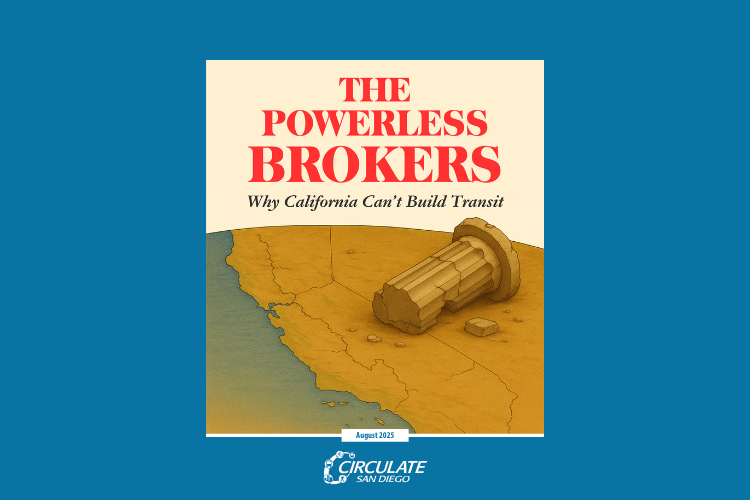
The report tittle is a play on Robert Caro’s legendary biography of Robert Moses, “The Power Broker.” While Moses was the infamous and unstoppable master builder of New York, many transit agencies in California struggle to build, and find themselves powerless.
In recent decades, many reforms were adopted to prevent the abuses of Moses-style planning. Those same reforms have created their own challenges, adding an array of new hurdles and veto points, limiting state capacity to get projects done quickly and cost-effectively.
For California to secure abundant public transit, it must empower transit authorities to build. This report contains a variety of recommendations, including to:
- Reassign permitting responsibility from third-parties to transit authorities themselves,
- Incentivize local governments to prioritize transit, adopt transparent standards, and streamline permitting,
- Extend CEQA exemptions for sustainable transportation, and
- Encourage more transit leadership from Caltrans.
PRESS
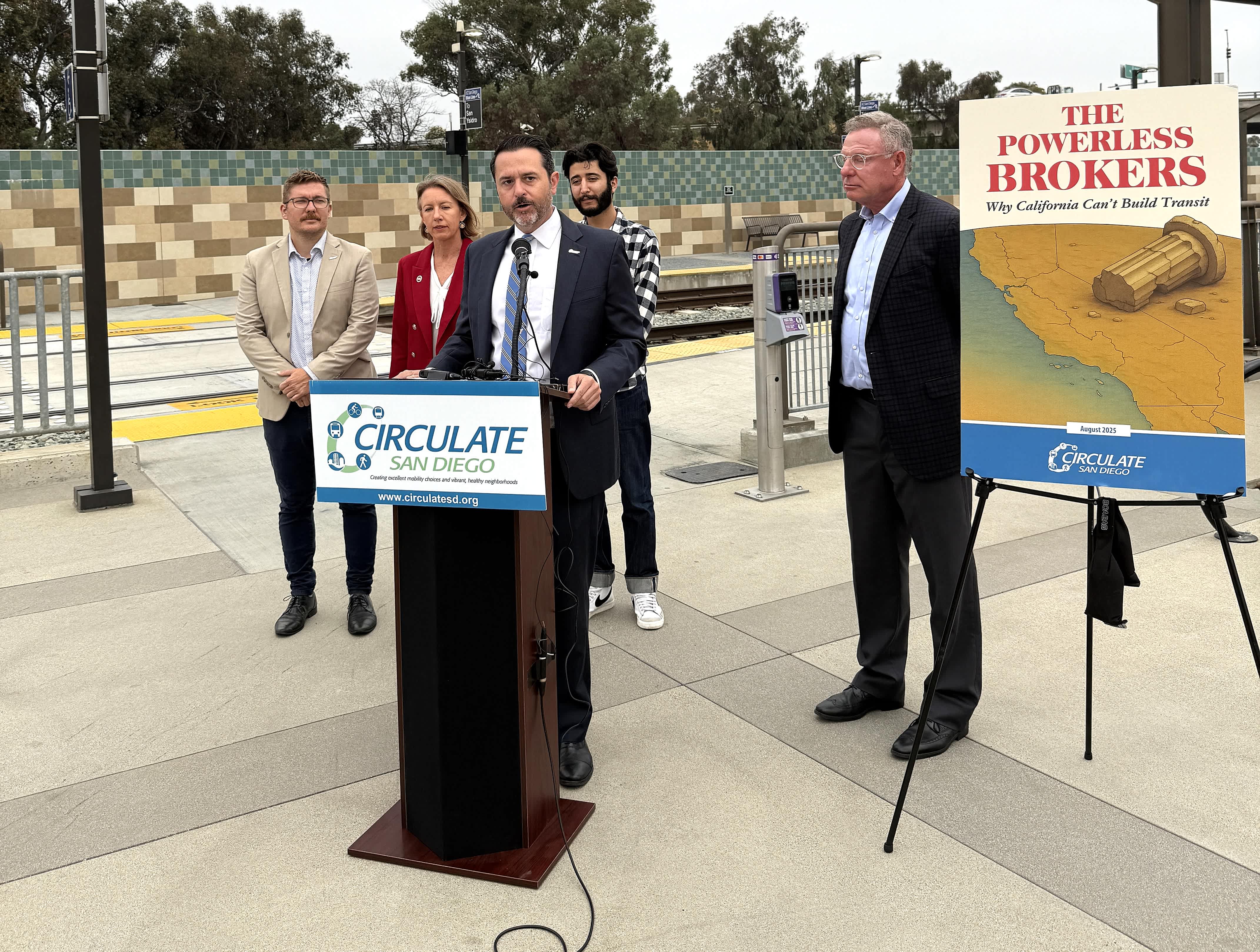
- MEDIA ADVISORY: Press Conference for Release of The Powerless Brokers 8/4, August 1, 2025
- PRESS RELEASE: Circulate San Diego’s Releases Latest Report: “The Powerless Brokers: Why California Can’t Build Transit," August 4, 2025
- VIDEO OF PRESS CONFERENCE, August 4, 2025
- How a generation of permitting requirements slows down California's transit projects, Los Angeles Times, August 4, 2025
- Local governments are a roadblock to California transit, report says, Axios, August 4, 2025
- 700+ permits: Why California can’t build the transit it votes for, San Diego Post, August 4, 2025
- San Diego nonprofit report highlights obstacles for California mass transit projects, ABC 10, August 4, 2025
- California getting in its own way when it comes to building mass transit: Report, City News Service, August 4, 2025
- Video: Cutting the red tape, KCRA 3 Sacramento, August 4, 2025
- Video: San Diego Transit Report, Fox 5, August 4, 2025
- Video: California getting in its own way when it comes to building mass transit, NBC 7, August 4, 2025
- 700+ permits: Why California can’t build the transit it votes for, Newsbreak, August 4, 2025
- Demandan agilizar proyectos, El Latino, August 4, 2025
- How a generation of permitting requirements slows down California's transit projects, Mass Transit, August 5, 2025
- Group provides blueprint for transit development, The Daily Transcript, August 6, 2025
- Experts look to San Diego Trolley to help fix California high-speed rail crisis, Times of San Diego, August 7, 2025
- Radio: A San Diego group has come out with a report and a plan to improve mass transportation projects in this state, 600 KOGO, August 7, 2025
- High-speed rail and the San Diego Trolley, Times of San Diego, August 8, 2025
- Powerless Brokers: New Reports Puts Blame on Local Permitting for Cost Overruns, Slow Delivery Time, for State Mega-Projects, Streets Blog California, August 8, 2025
- Radio: Why can't California build more public transit?, KPBS Midday Edition, August 11, 2025
- Podcast: Abundance in transportation, Freeway Exit, August 12, 2025
- California’s famous overregulation claims new victim: High-speed rail | Opinion, The Fresno Bee, August 12, 2025
- Podcast: Episode 545: The Powerless Brokers, The Overhead Wire, August 13, 2025
- Weber: Death by 1,000 towns — How rural cities and counties slowed high-speed rail to a crawl, East Bay Times, August 15, 2025
- Talking Headways Podcast: The Powerless Brokers, Streetsblog USA, August 15, 2025
- Program Recording: Reducing the Friction in Permitting Transit, Spur Event Page, August 8, 2025
- California Has a Transit Cost Problem — and a New Appetite to Deal With It, Spur, August 21, 2025
- CP&DR News Briefs September 9, 2025: S.F. Reforms; Gonzales Mega-Development; New National Monument; and More, California Planning & Development Report, September 9, 2025
- National links: A new kind of public utility, Greater Greater Washington, September 5, 2025
- #2540 The Deadly Status Quo, Bike Talk, October 10, 2025
- The Powerless Brokers: Why California Can’t Build Transit, Metro Magazine, October 22, 2025
- CP&DR News Briefs November 4, 2025: San Francisco "Family Zoning;" Housing Costs; Los Angeles Co. Depopulation; and More, November 4, 2025
- Watch "Colin Parent on ‘The Powerless Brokers’ and the Politics of Transit Change," YouTube, November 5, 2025
